The Laparoscopic Robot Assisted Systems Market size is expected to reach US$ 5,002.32 Million by 2031 from US$ 2,387.52 Million in 2024. The market is estimated to record a CAGR of 11.14% from 2025 to 2031.
Executive Summary and Global Market Analysis:
The global laparoscopic robot assisted systems market is experiencing significant growth driven by increasing adoption of robotic-assisted surgery, advancements in surgical precision, and shorter recovery times and patient preference. Laparoscopic robot assisted systems encompasses surgical robotic platforms, robotic arms/manipulators, robotic instruments, and robotic imaging and visualization systems. Robot-assisted surgical systems (RAS) are fundamentally changing surgery practice with unprecedented accuracy, dexterity, and visualization. The rise in popularity can be attributed to their ability to improve patient outcomes; they have been shown to lower blood loss in surgery by 85.3% compared to laparoscopy and 50.5% compared to open surgery.
Globally, the volume of robotic procedures will continue to expand, with more than 12 million da Vinci procedures performed worldwide as of May 2023 and a total of 2.68 million da Vinci procedures completed in 2024 (an 18% increase from the previous year). The integration of AI and machine learning will continue to increase RAS, with respects to enhanced preoperative planning, real-time decision support, and telesurgery, as illustrated by the intercontinental telesurgery, which established a world record in November of 2024, utilizing Microport's Toumai system, by Morocco and This continuous innovation, and the significant benefits that derived from being a patient and surgeon, will solidify RAS' role in the laparoscopic devices market.
Laparoscopic Robot Assisted Systems Market Segmentation Analysis:
Key segments that contributed to the derivation of the laparoscopic robot assisted systems market analysis are product, application, and end user.
- By product, laparoscopic robot assisted systems market is segmented into surgical robotic platforms, robotic arms/manipulators, robotic instruments, and robotic imaging and visualization systems. The surgical robotic platforms segment dominated the market in 2024.
- In terms of application, the market is segmented into general surgery, bariatric surgery, gynecological surgery, colorectal surgery, others. The general surgery segment held the largest share of the market in 2024.
- By end user, the market is segmented into hospitals and clinics, and ambulatory surgical centers. Hospitals and clinics segment held the largest share of the market in 2024.
Laparoscopic Robot Assisted Systems Market Drivers and Opportunities:
Increasing Adoption of Robotic Surgery Driving Laparoscopic Robot Assisted Systems Market
The growing acceptance of robotic surgery is a key factor driving the growth of the laparoscopic robotic-assisted systems market, as surgeons and health care providers are increasingly embracing robotic platforms for laparoscopic procedures given the improved control, precision, and dexterity they afford, resulting in improved patient outcomes. Laparoscopic robotic-assisted systems provide better range of motion and visualisation than laparoscopy, and are capable of performing complex procedures through small incisions, offering less trauma to the patient and faster recovery.
Robotic-assisted laparoscopic systems are being promoted in a growing number of surgical specialties including, but not limited to urology, gynecology, colorectal surgery, and general surgery. A number of studies have surfaced providing clinical evidence that supports and endorses the efficacy and safety of robotic-assisted laparoscopic techniques - thus encouraging hospitals and surgical centres to offer them. Furthermore, a new trend in reducing hospital stays and other postoperative complications is to entirely utilise and emphasize minimally invasive surgery which is a common approach among robotic systems. In all, robotic systems are becoming an increasingly favourite form of modern surgical care.
Penetration in Mid-tier Hospitals and Ambulatory Centers
The increasing penetration of laparoscopic robotic-assisted systems into mid-tier hospitals and ambulatory surgical centers offers an excellent opportunity to grow the market. Traditionally, high prices and space needed for robotic surgical platforms have limited the number of hospitals that were able to adopt robotic technology for surgical sessions to large, budget-crunched hospitals. However, as innovation continues to unfold, we are starting to see smaller and more affordable robotic systems be available allowing mid-tier healthcare organizations to incorporate robotic-assisted surgical technology into their operational framework. More healthcare providers are looking for ways to enhance surgical efficiency and attract more patients through efficiencies of care and minimally invasive procedures that are associated with laparoscopic robotic-assisted systems.
Similarly, the increasing competition amongst healthcare systems has encouraged mid-tier hospitals to invest in surgical technology and robotics support their surgical service and grow their patient base. The transition and shift of surgical care outside of hospitals and into outpatient settings has been increasingly prioritized as ambulatory surgical centers look for innovations such as robotics to increase processor safety, efficiency and outcomes for their patients. As robotics become accessible to a greater range of healthcare services and intraorganizational facilitators, we can expect to see significant growth in the laparoscopic robotic-assisted systems market.
Laparoscopic Robot Assisted Systems Market Size and Share Analysis
The laparoscopic robot assisted systems market is classified according to products into surgical robotic platforms, robotic arms/manipulators, robotic instruments, and robotic imaging and visualization systems. The surgical robotic platforms segment led the market in 2024 and beyond. Surgical robotic platforms represent the major product category in the laparoscopic robotic-assisted systems market because they serve as the core infrastructure integrating robotic arms, instruments, and imaging technologies.
In terms of applications, the market is segmented into general surgery, bariatric surgery, gynecological surgery, colorectal surgery, others. The general surgery segment had the largest market share in 2024. General surgery accounts for the largest application segment in the laparoscopic robotic-assisted systems market due to the wide range of common procedures performed using robotic assistance, such as cholecystectomy, hernia repair, and colorectal surgeries. The advantages of robotic systems—improved visualization, precision, and reduced invasiveness—are particularly valuable in general surgery, where delicate tissue handling and complex dissections are often required.
By end user, the market is segmented into hospitals and clinics, and ambulatory surgical centers. The hospitals and clinics segment held the largest share of the market in 2024. Hospitals and clinics are the key end users of laparoscopic robotic-assisted systems as they perform the most of multifaceted surgical procedures and have the set-up to aid the incorporation of cutting-edge robotic technologies. These healthcare set-ups are equipped to capitalize in expensive robotic platforms to improve surgical competences, advance patient results, and rise operative productivity, making them the important end users in this market.
Laparoscopic Robot Assisted Systems Market Report Highlights
Laparoscopic Robot Assisted Systems Market Report Coverage and Deliverables
The "Laparoscopic Robot Assisted Systems Market Size and Forecast (2021–2031)" report provides a detailed analysis of the market covering below areas:
- Laparoscopic robot assisted systems market size and forecast at global, regional, and country levels for all the key market segments covered under the scope
- Laparoscopic robot assisted systems market trends, as well as market dynamics such as drivers, restraints, and key opportunities
- Detailed SWOT analysis
- Laparoscopic robot assisted systems market analysis covering key market trends, global and regional framework, major players, regulations, and recent market developments
- Industry landscape and competition analysis covering market concentration, heat map analysis, prominent players, and recent developments for the laparoscopic robot assisted Systems market
- Detailed company profiles
Laparoscopic Robot Assisted Systems Market Country and Regional Insights
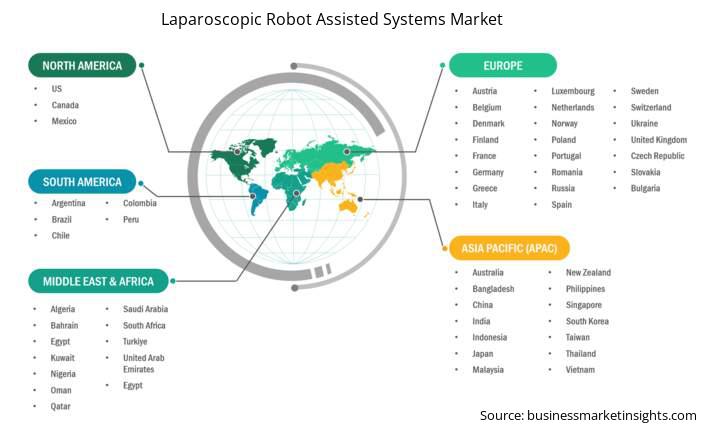
The geographical scope of the laparoscopic robot assisted systems market report is divided into five regions: North America, Asia Pacific, Europe, Middle East & Africa, and South & Central America. The laparoscopic robot assisted systems market in Asia Pacific is expected to grow significantly during the forecast period.
The Asia Pacific laparoscopic robot assisted systems market consists of China, Japan, India, South Korea, Australia, Bangladesh, New Zealand, Philippines, Singapore, Indonesia, Taiwan, Malaysia, Vietnam, and the Rest of Asia Pacific. The laparoscopic robotic-assisted systems market is expanding considerably within the Asia Pacific region aided by technological advances, increasing healthcare investments and growing demand for minimally invasive surgery. For example, in China, there are over 300 robotic systems installed in more than 250 institutions. These systems are performing over 350,000 procedures annually and especially in urology, where robotic assisted laparoscopic radical prostatectomy is common. Additionally, we are seeing nationally developed robotic platforms emerge in the robotic paradigm, for instance, MicroHand S and SkyWalker, both of which represent cost-effective solutions compared to the globally sourced modern robotic platforms which enable wider access to robotic-assisted surgery. The Indian robotic surgical ecosystem is evolving quickly, with leading medical institutions, such as the All India Institute of Medical Sciences (AIIMS), integrating surgical robots into general surgery departments. Moreover, private investment is growing into robotic surgery projects, and the government is increasingly investing in healthcare modernization projects.
In addition, the Asian nation continues to be a forerunner in robotic surgery, benefitting from broadly government supported robot-assisted surgery integration among clinical practice and healthcare delivery. Beyond India, Japan, for instance, a country with one of the oldest age populations in the world, has a very high demand for robotic assisted surgical procedures to treat chronic diseases. Additionally, South Korea continues to develop its healthcare system with growing investments in minimally invasive technologies. The shift toward preference for minimally invasive procedures is underscored by the rapid increase in the number of robotic surgical procedures, which take place there each year. Collectively, these factors define Asia Pacific as an emerging centre of excellence in the laparoscopic robotic-assisted surgical space.
Laparoscopic Robot Assisted Systems Market Research Report Guidance
- The report includes qualitative and quantitative data in the robot assisted systems market across product, application, and end user, and geography.
- The report starts with the key takeaways (chapter 2), highlighting the key trends and outlook of the laparoscopic robot assisted systems market.
- Chapter 3 includes the research methodology of the study.
- Chapter 4 further includes ecosystem analysis along with PEST analysis.
- Chapter 5 highlights the major industry dynamics in the laparoscopic robot assisted systems market, including factors that are driving the market, prevailing deterrents, potential opportunities and future trends. Impact analysis of these drivers and restraints is also covered in this section.
- Chapter 6 discusses the laparoscopic robot assisted systems market scenario, in terms of historical market revenues, and forecast till the year 2031.
- Chapters 7 to 10 cover laparoscopic robot assisted systems market segments by product, application, end user, and geography across North America, Europe, APAC, Middle East and Africa, South and Central America. They cover market volume revenue forecast and factors driving the market.
- Chapter 11 describes the competitive analysis along with the heat map analysis for the key players operating in the market.
- Chapter 12 describes the industry landscape analysis. It provides detailed description of various business activities such as market initiatives, new developments, mergers, and joint ventures globally, along with a competitive landscape.
- Chapter 13 provides a detailed profile of the major companies operating in the laparoscopic robot assisted systems market. The companies have been profiled on the basis of their key facts, business description, products and services, financial overview, SWOT analysis, and key developments.
- Chapter 14, i.e., the appendix, is inclusive of a brief overview of the company, list of abbreviations, and disclaimer section.
Laparoscopic Robot Assisted Systems Market News and Key Development:
The laparoscopic robot assisted systems market is evaluated by gathering qualitative and quantitative data post primary and secondary research, which includes important corporate publications, association data, and databases. A few of the key developments in the laparoscopic robot assisted systems market are:
- Medtronic Plc announced that the Expand URO Investigational Device Exemption (IDE) clinical study, the largest such study for robotic-assisted urologic surgery ever conducted, met both primary safety and effectiveness endpoints. The prospective, multi-center, single-arm IDE study included 137 patients who underwent urologic procedures using the Hugo robotic-assisted surgery (RAS) system. (Source: Medtronic Plc, Company Website, April 2025)
- Johnson & Johnson MedTech, a global leader in surgical technologies and solutions, today announced the completion of the first cases in the clinical trial for the OTTAVA Robotic Surgical System. The cases mark the first clinical experience with the OTTAVA System. Chief of Minimally Invasive and Elective General Surgery UT Health Houston and the lead investigator for the clinical study, performed Roux-en-Y gastric bypass surgery using the OTTAVA Robotic Surgical System at Memorial Hermann-Texas Medical Center. (Source: Johnson & Johnson, Press Release, April 2025)
Key Sources Referred:
- The World Bank World Development Indicators
- World Health Organization (WHO)
- Indian Council of Medical Research (ICMR)
- Obesity Surgery Society of India
- Cancer Research UK
- Global Healthcare Academy
- BMC Medical Education
- The World Bank Group
- Eurostat
- LANCET
Laparoscopic Robot Assisted Systems Market Strategic Insights

Laparoscopic Robot Assisted SystemsMarket Report Highlights
| Report Attribute | Details |
| Market size in 2024 | US$ 2,387.52 Million |
| Market Size by 2031 | US$ 5,002.32 Million |
| Global CAGR (2025 - 2031) | 11.14% |
| Historical Data | 2021-2023 |
| Forecast period | 2025-2031 |
| Segments Covered |
By Product
|
|
Regions and Countries Covered
|
|
| North America | US, Canada, Mexico |
| Europe | Germany, Italy, France, U.K., Spain, Belgium, Netherlands, Luxembourg, Norway, Finland, Denmark, Sweden, Switzerland, Austria, Greece, Portugal, Russia, Poland, Romania, Czech Republic, Ukraine, Slovakia, Bulgaria |
| Asia-Pacific | China, Japan, South Korea, India, Australia, New Zealand, Indonesia, Malaysia, Philippines, Singapore, Thailand, Vietnam, Taiwan, Bangladesh |
| South and Central America | Brazil, Argentina, Chile, Colombia, Peru |
| Middle East and Africa | Saudi Arabia, United Arab Emirates, Kuwait, Bahrain, Qatar, Oman, Turkiye, South Africa, Egypt, Nigeria, Algeria |
| Market leaders and key company profiles |
|
Laparoscopic Robot Assisted Systems Market Country and Regional Insights